 |
TTY OV
1
A cross platform python terminal
|
|
TTY OV
1
A cross platform python terminal
|
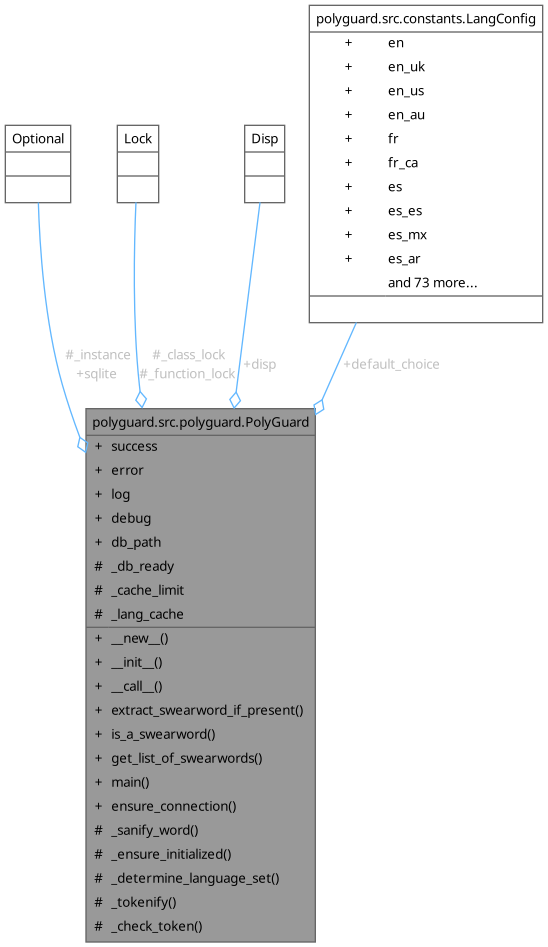
Public Member Functions | |
| "PolyGuard" | __new__ (cls, *args, **kwargs) |
| None | __init__ (self, POLY_CONST.LangConfig langs, Optional[str] db_path=None, int success=0, int error=1, bool log=True, bool debug=False) |
| int | __call__ (self, *Any args, **Any kwds) |
| Optional[str] | extract_swearword_if_present (self, str word, *, Optional[POLY_CONST.LangConfig] languages_to_check=None) |
| bool | is_a_swearword (self, str word, *, Optional[POLY_CONST.LangConfig] languages_to_check=None) |
| Dict[str, Set] | get_list_of_swearwords (self, *, Optional[POLY_CONST.LangConfig] languages=None) |
| int | main (self) |
| bool | ensure_connection (self) |
Data Fields | |
| success = success | |
| error = error | |
| log = log | |
| debug = debug | |
| POLY_CONST.LangConfig | default_choice = langs |
| db_path = POLY_CONST.DEFAULT_DB_PATH | |
| Optional[SQLiteHandler] | sqlite = None |
| dict | sqlite = {} |
Static Public Attributes | |
| Disp | disp = initialise_logger(__qualname__, False) |
Protected Member Functions | |
| Optional[str] | _sanify_word (self, str word) |
| bool | _ensure_initialized (self) |
| POLY_CONST.LangConfig | _determine_language_set (self, Optional[POLY_CONST.LangConfig] language) |
| List[str] | _tokenify (self, str text) |
| bool | _check_token (self, str text_low, POLY_CONST.LangConfig languages) |
Protected Attributes | |
| Lock | _function_lock = Lock() |
| bool | _db_ready = False |
| int | _cache_limit = int(POLY_CONST.DEFAULT_CACHE_MAX_LANGS) |
| _lang_cache = OrderedDict() | |
Static Protected Attributes | |
| Optional | _instance = None |
| Lock | _class_lock = Lock() |
Singleton profanity filter with multilingual support and LRU caching.

Manages a persistent connection to an SQLite database of language-specific
word lists. Provides thread-safe word detection with per-language caching
to optimize repeated lookups. Supports configurable language subsets and
can check single words or phrases.

Note:
    This class uses the singleton pattern. Multiple instantiations return
    the same instance.
Definition at line 45 of file polyguard.py.
| None polyguard.src.polyguard.PolyGuard.__init__ | ( | self, | |
| POLY_CONST.LangConfig | langs, | ||
| Optional[str] | db_path = None, | ||
| int | success = 0, | ||
| int | error = 1, | ||
| bool | log = True, | ||
| bool | debug = False ) |
Initialize the PolyGuard instance.

On first call, attempts to establish a persistent database connection.
If the connection fails, the instance will attempt to reconnect on demand.

Args:
    langs (LangConfig): LangConfig instance specifying which languages to check.
    db_path (Optional[str]): Path to the SQLite database. Default: None (package default).
    success (int): Exit code for successful initialization. Default: 0.
    error (int): Exit code for failures. Default: 1.
    log (bool): Enable logging output. Default: True.
    debug (bool): Enable debug-level logging. Default: False.
Definition at line 73 of file polyguard.py.
| int polyguard.src.polyguard.PolyGuard.__call__ | ( | self, | |
| *Any | args, | ||
| **Any | kwds ) |
Callable interface. Delegates to main().

Returns:
    int: Result code from main() (0 for success, non-zero for error).
Definition at line 117 of file polyguard.py.
| "PolyGuard" polyguard.src.polyguard.PolyGuard.__new__ | ( | cls, | |
| * | args, | ||
| ** | kwargs ) |
Create or return singleton instance.

Returns:
    PolyGuard: The singleton instance.
Definition at line 62 of file polyguard.py.
|
protected |
Check if a single token exists in any enabled language's word list.

Internal method that performs the actual word lookup using cache and
database queries. Token must already be lowercased.

Args:
    text_low (str): Lowercased token to search for.
    languages (LangConfig): LangConfig specifying which languages to query.

Returns:
    bool: True if token found in any enabled language, False otherwise.

Raises:
    RuntimeError: If database connection becomes unavailable mid-check.
Definition at line 274 of file polyguard.py.
|
protected |
Resolve language configuration, falling back to default if needed.

Args:
    language (Optional[LangConfig]): Language config override. Default: None.

Returns:
    LangConfig: Provided language config or default instance config.
Definition at line 155 of file polyguard.py.
|
protected |
Ensure database is initialized on first use.
Definition at line 149 of file polyguard.py.
|
protected |
Sanitize and normalize input word for processing.

Strips whitespace, converts to lowercase, and validates non-empty.

Args:
    word (str): Raw input word or phrase to sanitize.

Returns:
    Optional[str]: Lowercased, stripped word, or None if empty/invalid.
Definition at line 125 of file polyguard.py.
|
protected |
Tokenize text by splitting on whitespace after removing delimiters.

Uses pre-computed translation table for fast processing. Employs CPython's
optimized .split() fast-path (any-whitespace split with empty filtering).

Args:
    text (str): Text to tokenize (assumed already lowercased).

Returns:
    List[str]: List of non-empty token strings.
Definition at line 168 of file polyguard.py.
| bool polyguard.src.polyguard.PolyGuard.ensure_connection | ( | self | ) |
Ensure a persistent SQLiteHandler is created and connected.

Creates a new handler if needed or reconnects an existing one.
Cleans up stale connections gracefully.

Returns:
    bool: True if connection is now open and usable, False otherwise.
Definition at line 427 of file polyguard.py.
| Optional[str] polyguard.src.polyguard.PolyGuard.extract_swearword_if_present | ( | self, | |
| str | word, | ||
| * | , | ||
| Optional[POLY_CONST.LangConfig] | languages_to_check = None ) |
Extract first profanity match from word or phrase.

Tokenizes input and checks each token against enabled language word lists.
Returns immediately on first match for efficiency.

Args:
    word (str): The word or phrase to check.
    languages_to_check (Optional[LangConfig]): Language config override. Default: None.

Returns:
    Optional[str]: First matching swearword token found, or None if none detected.
Definition at line 183 of file polyguard.py.
| Dict[str, Set] polyguard.src.polyguard.PolyGuard.get_list_of_swearwords | ( | self, | |
| * | , | ||
| Optional[POLY_CONST.LangConfig] | languages = None ) |
Retrieve all swearwords for enabled languages.

Returns cached word sets if loaded, otherwise queries database.
Useful for inspection, testing, or bulk operations.

Args:
    languages (Optional[LangConfig]): Language config override. Default: None.

Returns:
    Dict[str, Set]: Dictionary mapping language names to sets of profanity words.
        Empty dict if database connection unavailable.
Definition at line 239 of file polyguard.py.
| bool polyguard.src.polyguard.PolyGuard.is_a_swearword | ( | self, | |
| str | word, | ||
| * | , | ||
| Optional[POLY_CONST.LangConfig] | languages_to_check = None ) |
Check if a word or phrase contains profanity.

Checks individual tokens in phrases and the full phrase itself.
Uses per-language LRU cache to optimize repeated lookups.

Args:
    word (str): The word or phrase to check (whitespace-stripped).
    languages_to_check (Optional[LangConfig]): Language config override. Default: None.

Returns:
    bool: True if any enabled language contains the word, False otherwise.
Definition at line 210 of file polyguard.py.
| int polyguard.src.polyguard.PolyGuard.main | ( | self | ) |
Probe the database and preload enabled languages into cache.

Attempts to verify database accessibility, then preloads up to
cache_limit languages into memory for faster lookup.

Returns:
    int: Success code (0) if DB ready, error code otherwise.
Definition at line 369 of file polyguard.py.
|
protected |
Definition at line 107 of file polyguard.py.
|
staticprotected |
Definition at line 59 of file polyguard.py.
|
protected |
Definition at line 104 of file polyguard.py.
|
protected |
Definition at line 88 of file polyguard.py.
|
staticprotected |
Definition at line 58 of file polyguard.py.
|
protected |
Definition at line 108 of file polyguard.py.
| polyguard.src.polyguard.PolyGuard.db_path = POLY_CONST.DEFAULT_DB_PATH |
Definition at line 97 of file polyguard.py.
| polyguard.src.polyguard.PolyGuard.debug = debug |
Definition at line 93 of file polyguard.py.
| polyguard.src.polyguard.PolyGuard.default_choice = langs |
Definition at line 94 of file polyguard.py.
|
static |
Definition at line 60 of file polyguard.py.
| polyguard.src.polyguard.PolyGuard.error = error |
Definition at line 91 of file polyguard.py.
| polyguard.src.polyguard.PolyGuard.log = log |
Definition at line 92 of file polyguard.py.
| polyguard.src.polyguard.PolyGuard.sqlite = None |
Definition at line 102 of file polyguard.py.
| dict polyguard.src.polyguard.PolyGuard.sqlite = {} |
Definition at line 324 of file polyguard.py.
| polyguard.src.polyguard.PolyGuard.success = success |
Definition at line 90 of file polyguard.py.
 1.12.0